Low Cost Couples Counseling: The Honest Map of Real Options
It's late, the bill math is running in your head, and the quote you got back for couples therapy was $200 a session you don't have. So you start typing "low cost couples counseling" into the search bar, hoping something real comes back instead of another ad. Here's the honest version: affordable help exists - sliding-scale clinics, graduate training clinics, EAPs, a couple of genuinely free programs - but the options are uneven, some carry months-long waitlists, and one or two of them aren't actually therapy. This is the map, ranked by how fast you can really start, with the exact words to say to get the lowest fee and how to find each option where you actually live.
Low cost couples counseling is real, and at most clinics a reduced fee is the norm, not a favor - roughly 4 in 5 mental-health facilities offer free or sliding-scale care. The catch is access, not existence: the cheapest options (graduate training clinics, community nonprofits) often have waitlists, and couples slots fill faster than individual ones. Start with sliding-scale and training clinics for the lowest in-person fee, an EAP or Open Path for speed, and a free evidence-based program tonight while you wait. And if you're the only one ready so far, that's common - you can still start your own side of the work today.
Why couples therapy costs more than you expect - and why insurance won't rescue you
The sticker shock is real, and it has two specific causes. First, couples sessions are usually priced above individual ones and run longer. One California therapist lists individual sessions at $160 and couples sessions at $175 for 55 minutes on her own fee page1 - and that's a mid-range private rate, not a coastal-city one. On Reddit the number people keep hitting is blunter. "Whenever someone post something, 8 out of 10 redditors suggest therapy but therapy is expensive! Without insurance it's $200…" one person wrote in 2.
Second, and this is the part that catches people off guard, insurance usually won't touch it.
That's not your plan being stingy; it's structural. Insurance pays to treat a diagnosable condition in one person. Relationship-only work is about what happens between you, so there's no single patient to bill for. Which is why so many people end up paying cash and feeling, as one person in 3 put it, that "the rates are wild - also, seems like no one takes insurance and we do not have reimbursement." It also means "low cost" has to mean something other than "use your benefits."
There's one real exception, and it's worth a single phone call before you write insurance off entirely. If one of you has a diagnosable condition - depression, anxiety, PTSD - some plans will pay for joint sessions when a therapist treats that condition with both of you in the room. Medicaid covers relationship-relevant care this way in some states, and a community mental-health center that takes it may run low-cost family or couples programs. None of it is guaranteed, so ask plainly - "do you cover couples sessions if one of us has a diagnosis?" - and don't build your plan around a yes.
And the cost barrier isn't in your head. Even where mental-health care is close to universal, money still shapes who walks through the door. A large Finnish cohort study found that people with less education and lower-status jobs used psychotherapy noticeably less4, with education the single strongest factor. When money is tight, the door is heavier. That's documented, not a personal failing. You're in the company of a lot of people who wrote some version of what one person posted in 5: "There is so much animosity, resentment, lack of intimacy, and we constantly fight. We truly cannot…" afford the help they know they need.
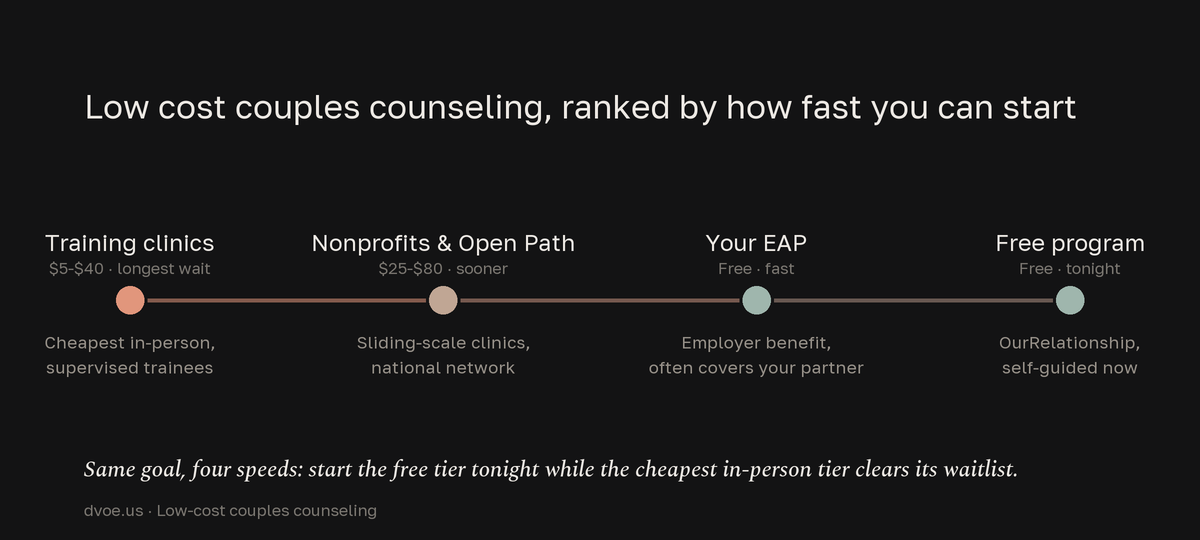
The real map of low cost couples counseling, ranked by how fast you can start
Here's the good news the search ads bury: at most clinics, free and reduced-fee care is the rule, not the exception. A national survey of mental-health treatment facilities found that about 4 in 5 offered services at no charge or on a sliding-fee scale6 (88% of outpatient centers). One honest caveat on that number: it counts facilities in general, and couples slots are thinner than individual ones - many clinics ration the couples spots because individual demand swamps them - so expect a wait even where the fee is low. The hard part isn't whether low cost exists. It's matching the right option to how much time you have. One more thing to set expectations: a couples session usually runs about 50 to 90 minutes, and the first one is mostly intake, them getting your history before any real work starts. Ranked roughly from cheapest-but-slowest to fastest, here's the map.
Graduate and university training clinics - cheapest in-person, if you can wait
Universities that train therapists run teaching clinics where supervised graduate clinicians see couples for very little, often $5 to $40 a session. Real, named examples exist all over the country: the University of Arizona Behavioral Health Clinic7, the Colorado State University Center for Family and Couple Therapy8, and the Alliant Couple and Family Clinic9.
The honest trade-off: you'll see a trainee, not a 20-year veteran (though a licensed faculty supervisor reviews the work), and demand is high. A redditor in 10 captured it exactly: "The Aspire clinic has low cost sliding fee scale counseling. It will be with a graduate student supervised by a professor. It's obviously in high demand." Translation: cheapest in-person fee on the map, but get on the waitlist now and have a backup.
Community nonprofits and sliding-scale clinics - the workhorse option
Below the training clinics in fee, and usually above them in availability, sit community mental-health centers, faith-based agencies, and low-fee nonprofit clinics. Fees scale to your income and the floors are low. From real recommendations people gave each other: in 11, "The Refuge Center : Operates on a sliding scale system based on income. Their sessions range between $25 - $110 per session." In 12, "We're a low-fee therapy clinic offering sliding scale sessions starting at $30." In 13, "Richland Oaks Counseling Center has sliding scale options and even some (limited) free sessions. Jewish Family Services also offers sliding…"
One quieter tip from this tier: a group is the cheapest format there is. A poster in 14 pointed to a center where "full fee prices start at $75" for an hour, "and we also have a 'sliding scale'," plus group options. If a relationship-skills group is on offer, it's often a fraction of the per-couple rate - ask for it by name.
Open Path Collective - a national shortcut
If hunting clinic-by-clinic feels like a second job, Open Path Psychotherapy Collective15 is a national network of therapists who hold reduced-fee slots: by its own listing, couples and family sessions run roughly $40 to $80, student-intern sessions around $30, after a one-time membership fee (about $65). It's for people who lack adequate insurance or can't manage typical market rates. It surfaces in city threads constantly - "You may be able to find a therapist through Open Path Collective- they have therapists listed for sliding scale rates," wrote someone in 16. The trade-off: a membership fee up front, and you still pay cash per session - but it's faster than cold-calling ten clinics.
Your EAP - possibly free, possibly already yours
This is the most overlooked free option on the list. Many employers offer an Employee Assistance Program: a set number of free counseling sessions per year, frequently covering household members, not just the employee. As one public example, Arizona's state EAP advertises 12 free counseling sessions per issue per year for benefits-eligible employees and anyone living in their household17. If you or your partner has one, that's free, fast, and private from your manager (a third party runs it). The limits: it's a short course, not open-ended therapy, and you'll want to confirm a couples session is allowed. Check your benefits portal or ask HR - quietly, with the script further down.
Online teletherapy - cheaper than the office, but cash-pay
Cash-pay teletherapy platforms undercut in-person couples therapy and remove the commute. Regain, for instance, lists its own pricing around $70 to $100 per session18. Cheaper than a $175 office hour, available from your couch after the kids are down. The honest caveats: it's still out of pocket (these aren't free), there's no independent outcome data proving any one platform works, and you're matched somewhat blindly. And if your real barrier isn't only money but time - no childcare, opposite shifts, no easy way across town - this and the self-guided programs below are the fix for that too, not just for the budget.
Free programs and relationship education - real, with limits
A genuinely free, evidence-based option most people have never heard of: OurRelationship19. It's an online program of about eight hours of guided activities you work through at your own pace over a few weeks, adapted from an in-person couples-therapy method, with an optional coach if you want one. You can start it tonight, at no cost. Separately, the federal government funds free healthy-marriage and relationship-education classes20 through community organizations. Important distinction: relationship education is skills training, not therapy. It can teach you to fight cleaner and listen better; it isn't a clinician treating a specific problem. Use it for what it is.
How to find these where you live, tonight
A national map only helps if it lands in your ZIP code. A few ways to surface the low-fee options near you tonight, wherever you are:
- Search by location on Open Path. Its reduced-fee network15 lets you filter therapists by area, in person or online.
- Filter a directory for sliding scale. Psychology Today's therapist directory lets you sort by your area and screen for sliding-scale and couples work - free to browse, no account needed.
- Find a marriage and family therapist through the AAMFT. The professional body for MFTs21 can point you to licensed members near you.
- Try the local training clinic. Search "[your nearest university] couple and family therapy clinic" - that's how you find the ones like Arizona and Colorado State above.
- Call your county or community behavioral-health department and ask what low-cost couples or family counseling they run or refer to. This is the route people forget, and it's often the cheapest door of all.
One reality check before you start dialing. Expect to contact more than one place, and don't read silence as rejection. A field experiment that contacted 725 Chicago therapists found 21.7% never returned the inquiry at all, and providers were measurably more responsive to people who could pay full fee than to those who asked for a sliding scale22. That bias is in the system, not in you. The fix is volume: send the same short message to five or six places at once, the way one person in 23 did, hunting for "an affordable ($35-$40 per session) in person (not telehealth) couples therapist." Whoever answers first wins.
| In-person therapy | Low-cost web program | |
|---|---|---|
| Reliable improvement | 74% of couples | 55% of couples |
| Satisfaction gains | Large | Large (~0.96) |
| Cost-effectiveness at scale | Loses | Wins decisively |
Does the cheap stuff actually work?
The fear underneath the budget is that low cost means low quality - that you'll get a watered-down version and waste the little money you have. The research says price isn't a good proxy for quality.
The cleanest evidence comes from comparing in-person couples therapy against a low-cost web program. In one comparison, the self-guided web program produced large gains in relationship satisfaction24 (a within-group effect size around 0.96). In-person therapy still helped a higher share of couples reach reliable improvement (74% vs 55%), so it isn't that cheaper is identical to a skilled clinician in a room. But the low-cost program won decisively on cost-effectiveness once it was serving more than a couple hundred couples. Cheaper and lighter-touch is not automatically worse.
Even very brief, very cheap formats move the needle a little. A randomized trial of a two-session group skills program for couples found small but real improvements in balance and psychological distress25 - supported, not miraculous, which is the honest register for anything in this price range. And the broader "stepped care" principle - start with the lightest, cheapest effective help and step up only if you need to - holds up in trials of other conditions, where a stepped approach matched fuller treatment at significantly lower cost26. What predicts a good outcome is the method and the fit between you and the person, not the size of the bill.
So if you're vetting a clinic, that's the thing to ask about. Find out whether they practice an evidence-based couples method like Emotionally Focused Therapy or Integrative Behavioral Couple Therapy, and how they'd work on whatever's actually stuck for you - the conversation that keeps breaking down, the same fight on a loop, the distance, the trust you're trying to rebuild. A cheaper therapist using a real method beats an expensive one who's winging it.
What if you're the only one ready?
Here's the part the option lists skip: a lot of people reading this are the only one in the relationship who wants help right now. That's common, and it isn't doom. You don't have to wait for perfect buy-in to start. Getting clear on your own side - what you actually feel underneath the frustration, what you need, how to raise it without a fight igniting - shifts the relationship even before your partner sits down, and the research backs a real (if smaller) benefit from doing that work on your own: guided self-help has medium-sized effects27 for things like anxiety. Often the trying partner moving first is exactly what gets the other one to the table.
While you're calling around and sitting on a waitlist, there's one part of this you can start tonight, for free: your own side of it. That's what we're building dvoe for - an AI relationship coach that never takes sides, with a private space just for you and a shared one for both of you when your partner's ready. It's coaching, not therapy, and it's not a stand-in for a licensed counselor when you truly need one. It's the zero-cost, zero-waitlist place to begin the work instead of stalling for months. Coming soon - leave your email and we'll bring you in early.
Copy-paste: what to actually say to get the lowest fee
Since many providers go quiet on sliding-scale requests, how you ask matters more than people realize. And one worry that stops people from asking at all: do you have to prove you're broke? Sliding scale just means the fee is set to what you can pay. Some places ask for a rough income figure or a recent pay stub; plenty just take your word for it. You don't have to work out where you land before you call - that's what "what do you need from us to qualify?" in the first script is for. Paste these and adjust the details.
- To a sliding-scale clinic or nonprofit: "Hi, my partner and I are looking for couples counseling and we need to use your sliding scale. What's the lowest fee you offer, and what do you need from us to qualify? If there's a waitlist, can you add us now while we sort out the paperwork?"
- To get on a training-clinic list: "Hi, I'd like to put my partner and me on the waitlist for couples counseling with a supervised trainee. We're flexible on day and time and fine starting with whoever's available first. What's the current wait, and is there anything we can fill out today to hold our place?"
- To any therapist whose rate is too high: "Your rate is more than we can manage right now. Do you hold any reduced-fee or sliding-scale spots, or could you point me to a colleague or clinic who does? We're serious about starting - we just need it to be sustainable."
- To your EAP or HR, without oversharing: "Hi, I'd like to use my EAP counseling benefit. Can you tell me how many sessions are covered, whether my partner can attend with me, and whether anything from these sessions is shared with my employer?"
Two things make these work. Send the clinic ones to several places the same evening - treat it like applying to jobs, not picking the one. And always ask for "the lowest fee," not just "do you take insurance." The lowest number is often a quiet option they don't advertise.
What you can do tonight, while you're on a waitlist
A waitlist isn't nothing-time. Some of the most useful relationship work is free and self-directed. The free OurRelationship program19 is built for exactly this gap, and two communication tools cost nothing to practice: "I" statements instead of blame, and the simple "when you do X in situation Y, I feel Z" formula that turns an accusation into something your partner can actually hear.
Keep the ceiling honest, though. Self-directed work helps, but in head-to-head tests it tends to help less than working with an actual clinician28. So treat tonight's effort as a real first step that makes the eventual sessions land better - not as the finish line, and not as proof you don't need the human help you're waiting on. The healthiest version of this is low cost plus a person when you can reach one, not low cost forever as a substitute.
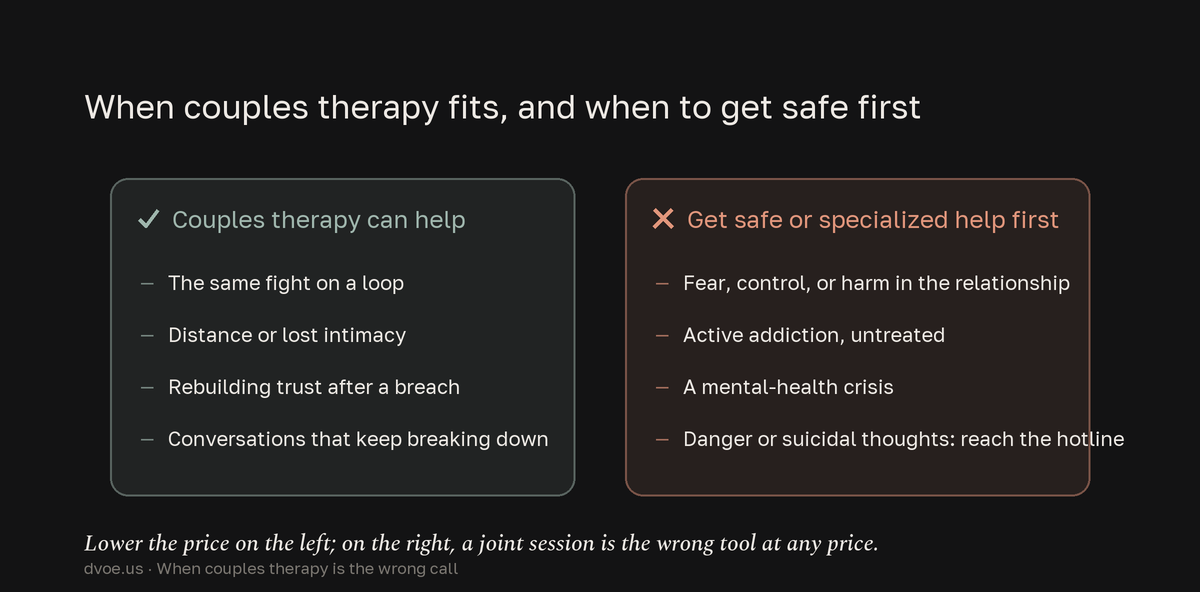
The hard limit: when couples counseling is the wrong call, at any price
There's one situation where the goal stops being "find this cheaper" and becomes "get safe first." If there's fear in the relationship - if one of you controls, frightens, or hurts the other - sitting together in a joint session can be the wrong, and unsafe, setting. This isn't a budget question, and it's not a judgment of you. It's the standard the field itself holds.
The same researchers note that safety assessment should be done with each partner separately and privately, and that protecting the person at risk is the priority over the joint work. If any of that is your situation, please skip the waitlist math and reach a person who can help right now.
Abuse isn't the only place a cheaper couples session is the wrong first move. If active addiction or a mental-health crisis is in the picture, that usually needs its own treatment first or alongside the relationship work - couples sessions stacked on top of an untreated crisis tend to spin. Sequence the specialized help first, then come back to the joint work.
So where should you start?
If you have an EAP, use it first - it's usually free and fast. No EAP? Open Path gets you a reduced-fee therapist quickly, while a graduate training clinic or community nonprofit gets you the lowest in-person fee if you can take a waitlist - search by your ZIP, or call your county behavioral-health line to find them. Send the copy-paste message to several places tonight, not one. Start a free program or your own side of the work this evening so the time isn't wasted, especially if your partner isn't ready yet. And if there's any fear or harm in the picture, that's not a pricing decision - reach the hotline.
You don't need a perfect plan or a full budget to begin. One person in 32 said the quiet thing out loud: "Can't afford to pay 200$ a session but I would like to heal my family ya know…?" You can. The version you can afford is a real version - it just takes a little hunting and a head start you can make tonight.
Common questions
What can you do if you can't afford couples therapy?
Start with the cheapest in-person options - graduate training clinics and community nonprofits on a sliding scale, where fees often run from about $5 to $40, with the occasional free slot. Use an EAP through your or your partner's job if you have one. Try Open Path Collective for a national sliding-scale network, search Psychology Today or call your county behavioral-health line to find local options, and begin a free program like OurRelationship tonight while you wait. Contact several providers at once; many never reply to sliding-scale requests, so silence is about the system, not you.
How do you get couples counseling for free?
The most reliable free routes are an EAP (many employers cover several sessions per issue per year, sometimes for household members), free or near-free slots at community and faith-based nonprofits, and free self-guided programs like OurRelationship. Federally funded healthy-marriage classes are free too, but that's relationship education, not therapy. Truly free licensed couples therapy is rare, so treat free as a starting point, not the whole plan.
What is the 5-5-5 rule in couples therapy?
It's a popular free communication exercise, not a clinical technique. The common version: when something's heated, each of you gets five uninterrupted minutes to say your piece, then five minutes to talk it through together, then five minutes to reconnect before you walk away. Think of it as a structured cool-down you can run at the kitchen table. It can lower the temperature, but there's no real evidence base behind the specific formula, and it's no substitute for actual couples work when something deeper is stuck.
Is cheaper or sliding-scale couples therapy any good?
Price isn't a proxy for quality. In one comparison, a low-cost web-based couples program produced large gains in relationship satisfaction, and while in-person therapy helped a somewhat higher share of couples, the cheaper program won on cost-effectiveness. Training-clinic trainees are supervised by experienced faculty. What matters most is the method and the fit, not the size of the bill - ask whether a clinic uses an evidence-based approach like Emotionally Focused Therapy or Integrative Behavioral Couple Therapy.
Does insurance ever cover couples counseling?
Usually not. Insurance pays to treat a diagnosable condition in one person, and relationship-only couples work has no single "identified patient" to bill for. Some plans, and Medicaid in some states, will cover sessions if one partner has a qualifying diagnosis and the work is coded around that, but you can't count on it. That's the main reason so much couples counseling is paid out of pocket.